Friday, July 17

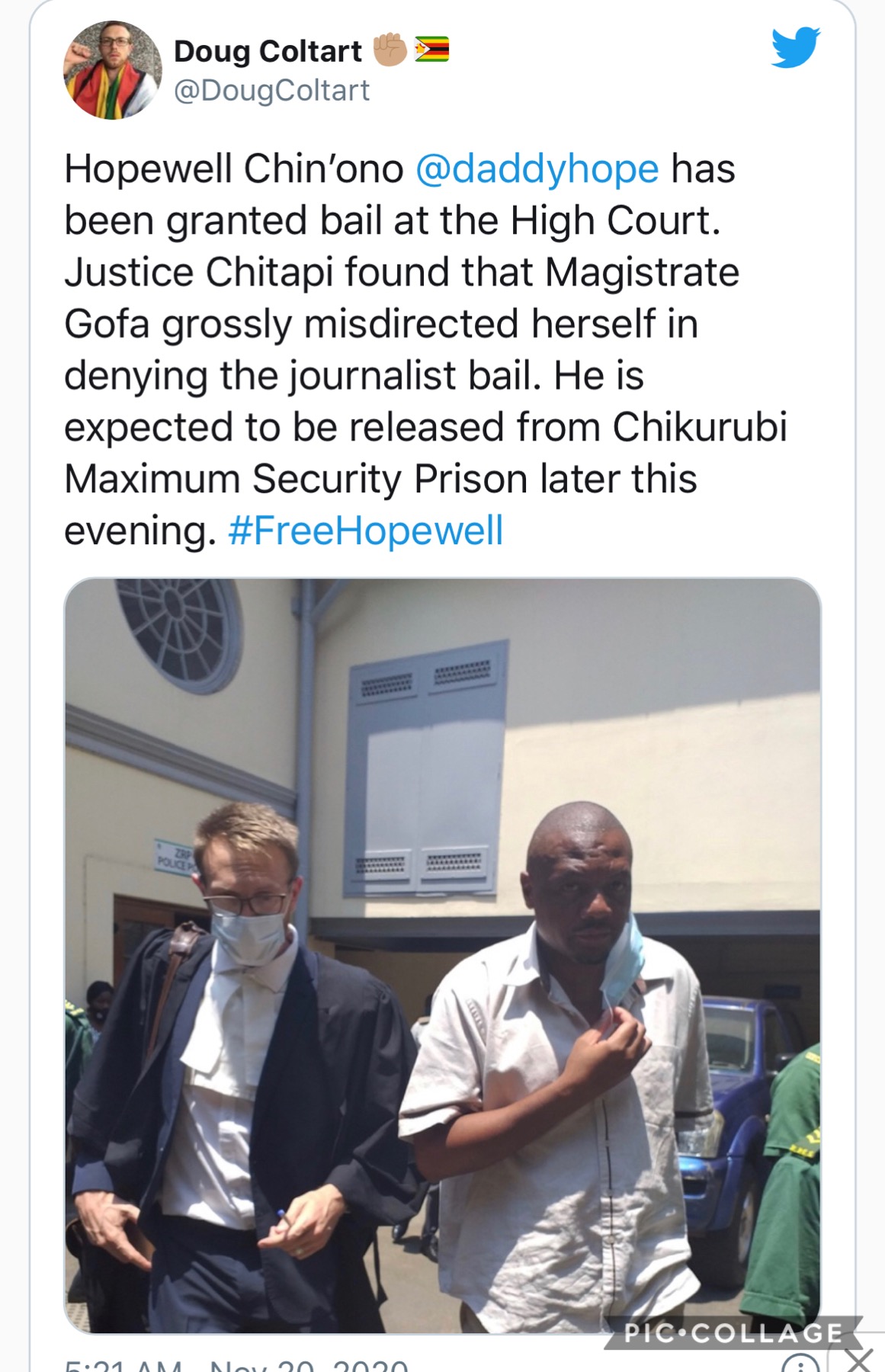
Hopewell Chin’ono Finally Gets Bail After 2 Weeks At Chikurubhi

After more than two weeks in prison, multiple court appearances, and fears of Covid-19 and bronchitis infection, prominent investigative journalist Hopewell Chin’ono was granted bail today.

High Court Judge Justice Tawanda Chitapi granted bail to Hopewell Chin’ono who is being charged with obstructing the course of justice.

This development was announced by one of his lawyers Doug Coltart on his Twitter handle

Chitapi granted Chin’ono an appeal for bail today after he was denied bail last week by Harare regional magistrate Marehwanazvo Gofa. Judge Justice Chitapi went on to accuse magistrate Gofa of misdirecting herself when she claimed Chin’ono had a propensity to commit crimes.

The objective of the remand process is not to find the accused guilty or not.”

“The learned magistrate was grossly misdirected when she referred that the accussed person was guilty on a reasonable suspicion basis,” he said

In granting him bail, Judge Chitapi did not add new bail conditions except that Hopewell Chin’ono should not use Twitter to obstruct the course of justice.

Chin’ono is set to be guided by the bail conditions he was given when he was charged with inciting violence in connection with the 31st July protests.

Zimbabwean prominent freelance journalist and documentary filmmaker, Hopewell Chin’ono has been freed on bail is expected to be released later this evening.

Granting bail, High Court judge Justice Chitapi found that Magistrate Gofa grossly misdirected herself in denying the journalist bail.

The CNN Africa Journalist of the year award winner was arrested over two weeks ago over a tweet in which he suggested that Zimbabwe Mining Federation president, Ms Henrietta Rushwaya, charged with gold smuggling would be released on bail.

The state argued that the tweet was an obstruction of justice and was in violation of the journalist’s bail conditions for his incitement of violence case.

His arrest over 2 weeks ago was the 2nd time he’d been arrested this year after he was arrested on 20 July for rallying the citizenry to participate in the foiled 31 July anti-corruption protests which had been convened by Jacob Ngarivhume of opposition Transform Zimbabwe

  • Share:

Info News

Debt Consolidation Loans: Pros, Cons, and Rates

Debt Consolidation Loans: Pros, Cons, and Rates

Debt consolidation loans allow borrowers to combine multiple debts into one payment. This can be helpful if you have credit card balances, personal loans, or high-interest debt.

Many people use a personal loan for debt to pay off credit cards. Instead of several monthly payments, you make one fixed payment to the lender.

Benefits of Debt Consolidation

Debt consolidation may lower your interest rate, simplify payments, and help you create a clear repayment plan. It may also help improve your credit over time if you make payments on schedule.

Risks to Consider

Consolidation is not a solution if spending habits do not change. If you pay off credit cards and then use them again, you may end up with more debt.

Final Thoughts

Before applying, compare debt consolidation rates, fees, loan terms, and monthly payments. A debt consolidation loan can be useful, but only when part of a responsible financial plan.

Homeowners Insurance: What Your Policy May Not Cover

Homeowners insurance protects one of your biggest investments, but many people do not fully understand what their policy covers. They only find out after damage happens, and by then it may be too late.

A standard homeowners insurance policy may cover damage from fire, wind, theft, vandalism, certain water damage, and liability claims. It may also help pay for temporary housing if your home becomes unlivable after a covered event.

However, there are important exclusions. Many standard policies do not cover flood damage. If you live in an area with flood risk, you may need separate flood insurance.

Earthquake damage is also usually excluded unless you buy additional coverage. Sewer backups, mold, termite damage, wear and tear, and maintenance problems may also be limited or excluded.

Another important issue is replacement cost versus actual cash value. Replacement cost coverage may pay to replace damaged property with new items. Actual cash value coverage subtracts depreciation, which can result in a lower payout.

Your policy limits matter. If your home has increased in value or construction costs have gone up, your old coverage may not be enough to rebuild. You should review your policy regularly to make sure the dwelling coverage is accurate.

Personal property coverage also has limits. Expensive jewelry, electronics, art, firearms, or collectibles may require additional coverage.

Liability protection is another important part of homeowners insurance. If someone is injured on your property, liability coverage may help pay legal costs or damages.

To avoid surprises, review your declarations page, exclusions, deductibles, and coverage limits. Ask your insurance agent what is not covered and whether you need additional protection.

Homeowners insurance is not just a bill. It is financial protection for your house, belongings, and future. Understanding your policy before disaster strikes can save you from major financial stress.