Following his sentencing last week, former South Africa President Jacob Zuma claims that he is too old for jail.
Addressing the media on Sunday evening, Jacob Zuma said sending him to jail during the height of a pandemic at his age was the same as sentencing him to death.
The former president said he wasn’t seeking to destruct the work of the state capture commission, but all he is asking for is fairness and consistency in the application of the law. He however said South Africa was sliding back into apartheid-like rule
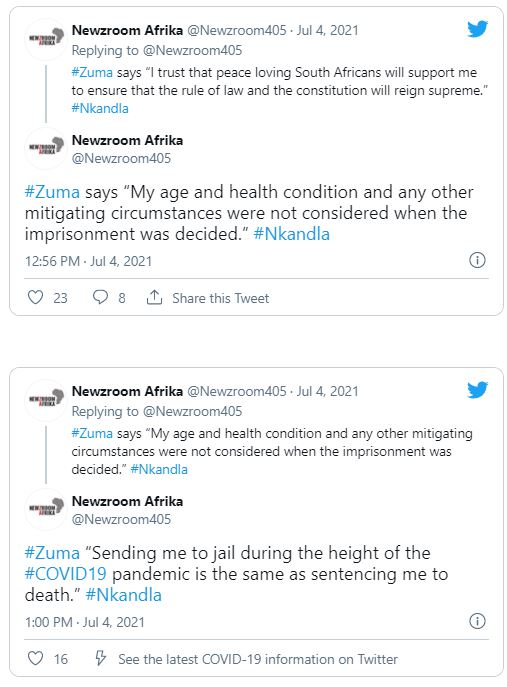
“The fact that I was sentenced without trial should induce shock to all those who cherish the rule of law. The rule of law doesn’t deal harshly with those you may dislike for whatever reason. South Africa is sliding back to apartheid-like rule. I am facing detention without trial. Elsewhere the Secretary-General of the ANC has a banning order, prohibiting him from addressing the masses. We have a level 4 lockdown and a curfew of the 1980s. The only difference is we only use different levels, like contempt of court instead of detention without trial, but the substance is the same,” he said.
Jacob Zuma was sentenced to 15 months in prison by the Constitutional Court of South Africa.
This comes after Zuma was found guilty of contempt of court when he defied a court order issued by the Constitutional Court for him to appear before the Zondo Commission of Inquiry into State Capture.
His family has since vowed to defend him from going to prison.
Related Story
Former South African president Jacob Zuma granted appeal to jail sentence
Constitutional court agrees to hear challenge to 15-month prison-term, as Zuma rallies political support
Jacob Zuma, the former president of South Africa, appeared on Saturday to have won a reprieve from imminent imprisonment on contempt of court charges after the country’s most senior judges agreed to hear his challenge to a 15-month jail sentence awarded last week.
Police were ordered to arrest the 79-year-old by the supreme court if he did not surrender to authorities by Sunday after he failed to appear before a corruption inquiry earlier this year.
Zuma was ousted as president amid multiple graft scandals in 2018 after nine years in power and has consistently refused to cooperate with judges investigating wrongdoing during his rule.
In recent days, the veteran politician has sought to rally political support, particularly in his stronghold of KwaZulu-Natal province where he appeared briefly in public on Saturday, but his efforts to spark any broader protests at his impending arrest have so far failed.
A small crowd gathered outside Zuma’s homestead of Nkandla. Supporters included about two dozen women who said they had travelled more than 300km overnight from the neighbouring Eastern Cape province.
“We support Zuma and we want to know what is going to happen with him, which is why we are here,” 43-year-old Cecilia Nongce said, wearing a traditional Nguni blue-and-red blanket to ward off the cold.
“We love Nxamalala ,” she said in Zulu, referring to Zuma by his traditional clan name, adding that they hoped he would come out to speak to them.
A group of other supporters arrived in two mini-buses waving ANC flags and wearing white T-shirts with the inscription ‘wenzeni uZuma’, Zulu for “What has Zuma done?”
Analysts in South Africa were surprised by the supreme court’s decision to consider the former president’s challenge to its own decision.
“If Zuma goes to prison, we can say we have the rule of law in South Africa. If he doesn’t, then we don’t. There is no new evidence, so this means the system is being bent to fit the politics and people everywhere will be very disappointed by that,” said Ralph Mathekga, an author and political commentator.
In its judgment last week, the South African supreme court noted that the former president had “repeatedly reiterated that he would rather be imprisoned than to cooperate “with the corruption inquiry”.
Zuma then submitted a 30-page statement, accusing judges of “exasperation” and suggesting that the supreme court “reassess whether it has acted within the constitution”.
The statement also said that Zuma’s health would be at risk in prison because he would not be able to receive the care that he needs and might catch Covid-19.
The contempt of court charges related to Zuma’s consistent failure to appear at the corruption inquiry led by South Africa’s deputy chief justice, Raymond Zondo, in February.
Scores of witnesses have described what appears to have been widespread corruption and misadministration under Zuma’s rule, but the former president has testified only once, in July 2019, before staging a walkout days later. He denies all wrongdoing.
In February, Zondo said he would seek an order from the constitutional court to force Zuma to testify or go to prison because otherwise “the message … sent out is that people can ignore or disregard summons and orders of courts with impunity …[and] there will be very little that will be left of our democracy.”
Zuma has accused Zondo of being biased and saying that allegations against him were formulated by various actors involving overseas intelligence agencies.
Most of the alleged corruption under investigation by the commission involves three brothers from a wealthy Indian business family, the Guptas, who won lucrative government contracts and were allegedly even able to choose cabinet ministers.
South African media have been supportive of the Constitutional court.
“His diehard fans trumpet his contribution to ….the transition to a successful democracy. They are absolutely correct; Zuma was a patriot – and as a patriot he should submit himself to the laws and institutions of this country,” said the Independent online news website.
Mathekga said most South Africans wanted to see the rule of law upheld. “If the constitutional [supreme] court is dithering what does it say about our institutions?” he said.
Zuma’s successor as president, Cyril Ramaphosa, a labour activist turned wealthy tycoon, has taken steps to stamp out corruption. Ramaphosa took over as South Africa’s president after a bitter internal battle within the ANC and amid public outrage over allegations of mismanagement and systemic corruption.
Anger has been fuelled by a series of scandals involving huge sums corruptly earned on government contracts for emergency supplies to combat the Covid-19 pandemic and grants to support the most needy.
In the past few days, new Covid restrictions have been introduced in an attempt to stem a sharp rise in cases driven by the spread of the more transmissible Delta variant, weak countermeasures and public fatigue with existing restrictions.
Zuma is separately facing 16 charges of fraud, graft and racketeering relating to a 1999 arms deal, to which he has pleaded not guilty.
Related Story
Former South African president Jacob Zuma granted appeal to jail sentence
Constitutional court agrees to hear challenge to 15-month prison-term, as Zuma rallies political support
Jacob Zuma, the former president of South Africa, appeared on Saturday to have won a reprieve from imminent imprisonment on contempt of court charges after the country’s most senior judges agreed to hear his challenge to a 15-month jail sentence awarded last week.
Police were ordered to arrest the 79-year-old by the supreme court if he did not surrender to authorities by Sunday after he failed to appear before a corruption inquiry earlier this year.
Zuma was ousted as president amid multiple graft scandals in 2018 after nine years in power and has consistently refused to cooperate with judges investigating wrongdoing during his rule.
In recent days, the veteran politician has sought to rally political support, particularly in his stronghold of KwaZulu-Natal province where he appeared briefly in public on Saturday, but his efforts to spark any broader protests at his impending arrest have so far failed.
A small crowd gathered outside Zuma’s homestead of Nkandla. Supporters included about two dozen women who said they had travelled more than 300km overnight from the neighbouring Eastern Cape province.
“We support Zuma and we want to know what is going to happen with him, which is why we are here,” 43-year-old Cecilia Nongce said, wearing a traditional Nguni blue-and-red blanket to ward off the cold.
“We love Nxamalala ,” she said in Zulu, referring to Zuma by his traditional clan name, adding that they hoped he would come out to speak to them.
A group of other supporters arrived in two mini-buses waving ANC flags and wearing white T-shirts with the inscription ‘wenzeni uZuma’, Zulu for “What has Zuma done?”
Analysts in South Africa were surprised by the supreme court’s decision to consider the former president’s challenge to its own decision.
“If Zuma goes to prison, we can say we have the rule of law in South Africa. If he doesn’t, then we don’t. There is no new evidence, so this means the system is being bent to fit the politics and people everywhere will be very disappointed by that,” said Ralph Mathekga, an author and political commentator.
In its judgment last week, the South African supreme court noted that the former president had “repeatedly reiterated that he would rather be imprisoned than to cooperate “with the corruption inquiry”.
Zuma then submitted a 30-page statement, accusing judges of “exasperation” and suggesting that the supreme court “reassess whether it has acted within the constitution”.
The statement also said that Zuma’s health would be at risk in prison because he would not be able to receive the care that he needs and might catch Covid-19.
The contempt of court charges related to Zuma’s consistent failure to appear at the corruption inquiry led by South Africa’s deputy chief justice, Raymond Zondo, in February.
Scores of witnesses have described what appears to have been widespread corruption and misadministration under Zuma’s rule, but the former president has testified only once, in July 2019, before staging a walkout days later. He denies all wrongdoing.
In February, Zondo said he would seek an order from the constitutional court to force Zuma to testify or go to prison because otherwise “the message … sent out is that people can ignore or disregard summons and orders of courts with impunity …[and] there will be very little that will be left of our democracy.”
Zuma has accused Zondo of being biased and saying that allegations against him were formulated by various actors involving overseas intelligence agencies.
Most of the alleged corruption under investigation by the commission involves three brothers from a wealthy Indian business family, the Guptas, who won lucrative government contracts and were allegedly even able to choose cabinet ministers.
South African media have been supportive of the Constitutional court.
“His diehard fans trumpet his contribution to ….the transition to a successful democracy. They are absolutely correct; Zuma was a patriot – and as a patriot he should submit himself to the laws and institutions of this country,” said the Independent online news website.
Mathekga said most South Africans wanted to see the rule of law upheld. “If the constitutional [supreme] court is dithering what does it say about our institutions?” he said.
Zuma’s successor as president, Cyril Ramaphosa, a labour activist turned wealthy tycoon, has taken steps to stamp out corruption. Ramaphosa took over as South Africa’s president after a bitter internal battle within the ANC and amid public outrage over allegations of mismanagement and systemic corruption.
Anger has been fuelled by a series of scandals involving huge sums corruptly earned on government contracts for emergency supplies to combat the Covid-19 pandemic and grants to support the most needy.
In the past few days, new Covid restrictions have been introduced in an attempt to stem a sharp rise in cases driven by the spread of the more transmissible Delta variant, weak countermeasures and public fatigue with existing restrictions.
Zuma is separately facing 16 charges of fraud, graft and racketeering relating to a 1999 arms deal, to which he has pleaded not guilty.
Info News
GLP-1 Weight Loss Without Insurance: Cost, Options, and What to Know
GLP-1 Weight Loss Without Insurance: What You Need to Know
Many people are searching for GLP-1 weight loss without insurance because coverage can be confusing, limited, or unavailable.
Some insurance plans cover weight loss medications. Some only cover them for diabetes. Some require prior authorization. Others do not cover them at all.
That leaves many people asking the same question: can I start a GLP-1 weight loss program without insurance?
The answer is yes, but you need to compare your options carefully.
GLP-1 medications are prescription treatments. They should be used under medical supervision, and the NIDDK advises people to talk with a health care professional about the risks and benefits before taking medication for obesity.
Why GLP-1 Costs Can Be High Without Insurance
Without insurance, the total cost may include several things:
Provider consultation
Lab work
Prescription medication
Follow-up visits
Nutrition support
Program membership
Shipping
Dose changes
Refills
Some people only look at the monthly program fee, but that may not include the medication. Others see a medication price but forget about lab work and follow-up visits.
The real cost is the full monthly or long-term cost.
What Affects the Cost?
1. Brand-Name Medication vs. Other Options
Brand-name medications may cost more, especially without insurance. Your provider should explain what is being prescribed, why, and whether it is appropriate for your health situation.
2. In-Person Clinic vs. Telehealth
In-person clinics may charge separately for visits, labs, injections, or coaching.
Telehealth programs may charge a monthly fee that includes provider access, but medication may still be separate.
3. Lab Work
Some programs require labs before starting. This can add cost, but it may also improve safety.
4. Follow-Up Frequency
More medical support may cost more, but it can also be valuable if you have side effects, dose questions, or health concerns.
5. Pharmacy Source
Medication source matters. Be cautious with extremely cheap offers, especially from unverified sellers.
The FDA has warned about unapproved and fraudulent GLP-1 products, including products marketed with false information on labels.
How to Compare GLP-1 Programs Without Insurance
Before you choose a program, compare these details:
Total Monthly Cost
Ask for the real cost, not just the starting fee.
Questions to ask:
Is medication included?
Are provider visits included?
Are labs included?
Are there refill fees?
Is shipping included?
Is coaching included?
Are there cancellation fees?
Provider Qualifications
You should know who is managing your care.
Ask:
Is the provider licensed in my state?
Will I meet with a real clinician?
How often can I contact the provider?
Who do I call if I have side effects?
Medication Source
This is one of the most important questions.
Ask:
What medication will I receive?
Is it FDA-approved?
What pharmacy fills it?
Is the pharmacy licensed?
Will I receive clear dosing instructions?
Follow-Up Care
A safe program should not disappear after payment.
Ask:
How often are check-ins?
What happens if I feel sick?
How are dose changes handled?
Will labs be repeated?
Do you help with maintenance?
Is Cheap GLP-1 Weight Loss Safe?
Cheap is not always unsafe, but extremely cheap offers should raise questions.
Be careful with:
Social media sellers
“Research use only” products
No-prescription offers
Mystery injections
No medical screening
No pharmacy information
No follow-up care
Unrealistic claims
If a product does not require a prescription, that is a serious warning sign.
What About Compounded GLP-1 Medications?
Compounded medications are a complicated topic.
The FDA has issued updated statements as GLP-1 supply has stabilized and has reminded compounders that certain legal conditions must be met for compounded drugs to qualify for exemptions.
The FDA has also proposed excluding semaglutide, tirzepatide, and liraglutide from the 503B bulks list, saying there is no clinical need for outsourcing facilities to compound those drugs from bulk substances.
For readers, the key point is simple: do not assume every compounded GLP-1 offer is safe, legal, or appropriate. Ask questions and use licensed medical professionals.
Can You Use HSA or FSA Funds?
Some people may be able to use HSA or FSA funds for eligible medical expenses, but rules vary. You should check with your plan administrator before assuming coverage.
Keep receipts, prescriptions, and provider documentation.
How to Save Money Safely
Here are safer ways to manage costs:
Check insurance requirements
Ask about prior authorization
Compare licensed telehealth providers
Ask your doctor about alternatives
Use manufacturer savings programs if eligible
Ask about lab pricing upfront
Avoid unnecessary add-ons
Focus on nutrition and exercise support
Plan for long-term costs before starting
Do not choose unsafe products just to save money.
Lifestyle Still Matters Without Insurance
If you are paying cash, you want every dollar to count. That means the medication should be paired with a strong lifestyle plan.
Focus on:
Protein at every meal
Vegetables daily
Water instead of sugary drinks
Walking most days
Strength training twice weekly
Sleep improvement
Stress control
Meal planning
The CDC recommends adults get at least 150 minutes of moderate-intensity aerobic activity weekly and muscle-strengthening activity at least 2 days per week.
What to Eat on a GLP-1 Program
Because appetite may drop, you need nutrient-dense meals.
Good options include:
Eggs
Greek yogurt
Chicken
Fish
Beans
Lentils
Lean meat
Tofu
Vegetables
Fruit
Oats
Sweet potatoes
Brown rice
Avocado
Olive oil
Avoid relying on tiny meals with poor nutrition. Weight loss should not mean malnutrition.
Common Mistakes People Make
Choosing Based Only on Price
Low price means nothing if the care is poor or the medication source is questionable.
Ignoring Side Effects
Digestive symptoms can happen. You need medical guidance if symptoms are severe or persistent.
Not Eating Enough Protein
Low appetite can lead to low protein intake. That may increase muscle loss risk.
No Maintenance Plan
What happens after you lose weight? That question should be answered early.
Final Thoughts
GLP-1 weight loss without insurance is possible, but it requires careful planning.
Compare total cost, provider quality, medication source, follow-up care, and long-term support. Avoid shortcuts that put your health at risk.
The best program is not just affordable. It is safe, transparent, medically supervised, and built for long-term success.
Personal Injury Lawyers: Understanding Your Legal Rights After an Accident
Personal injury lawyers help accident victims seek compensation for injuries caused by negligence or unsafe conditions. Common personal injury cases include car accidents, workplace injuries, medical malpractice, and slip-and-fall incidents. Legal representation can help injured individuals recover financial compensation for medical expenses, lost income, and emotional distress.
After an accident, gathering evidence is critical for building a strong legal case. Medical records, witness statements, photographs, and police reports can help establish liability and support compensation claims. Experienced attorneys understand how to negotiate with insurance companies and protect clients from unfair settlement offers.
Many personal injury law firms provide free consultations and work on contingency fee arrangements, meaning clients only pay legal fees if compensation is recovered. This allows injured individuals to access legal support without significant upfront costs.
Understanding legal rights and seeking professional guidance early can make a major difference in the outcome of a personal injury case. Victims should focus on recovery while allowing legal professionals to manage negotiations and court procedures.


