Friday, October 16

MDC Workers Have Not Been Paid Since February Nelson Chamisa

Opposition leader Nelson Chamisa has admitted that MDC Alliance workers haven’t been paid their salaries since February, and attributed the delay in salaries payment to the coronavirus pandemic. 

Without elaborating how the pandemic stopped the MDC from paying its workers, Chamisa said “MDC workers haven’t been paid during the coronavirus period.”

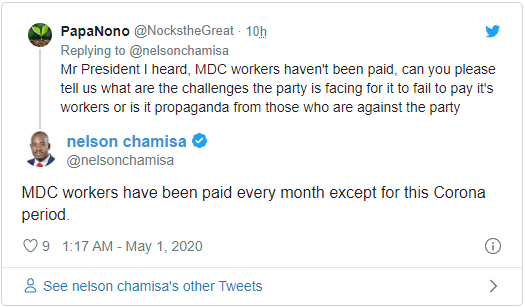
He was responding to a party supporter who asked him on social media if it was true that his party’s workers have been struggling to get their salaries. 

 
“Mr President I heard, MDC workers haven’t been paid, can you please tell us what are the challenges the party is facing for it to fail to pay it’s workers or is it propaganda from those who are against the party,” Chamsia was asked by a supporter.

“MDC workers have been paid every month except for this Corona period,” Chamisa responded. When asked how he expected them to survive the harsh economic environment without salaries, he could not respond.

Earlier on in his tweet, the embattled MDC leader had said workers are the heroes of any nation and deserved a legitimate Government.

“It’s #MayDay today. Workers in Zimbabwe have toiled endless days and nights, to build a nation of all our dreams. Sadly, many have no right to work in Zimbabwe.

Everyday is a workers’ day. Without labor, nothing moves. Workers demand decent lives and a working legitimate government! Save us!” said Chamisa. 

The revelations that workers at the party headquarters have gone for two months without getting their salaries came this week as a Government Minister hinted that the Treasury will be giving the Thokozani Khupe-led faction the $7.5 million of funds provided under the Political Parties Finance Act. It also came as reinstated MDC Secretary-General Douglas Mwonzora told the Daily News that efforts to engage the Chamisa faction have thus far hit a brickwall as the “other side has not been cooperative”.

Mwonzora, however, warned that further resistance could result in the party handing Chamisa and Chalton Hwende to the police on criminal charges.


 “We have not been furnished with the financial statements from the previous administration and we are in the process of finding out what the old administration did and we are still trying to find out.

“We do not know where the money for the wages of workers went, we don’t know where the more than $4 million they got last year went. 

“Workers have told us that they have not been paid in the past two months. We are not sure about the $4,5 million that was received by the party last year.

“We are in the process of redressing the humanitarian situation of the employees because they are the most affected by this lockdown and also failure on the leadership to pay them.

“What we noticed is that over 141 employees had been laid off unlawfully thus condemning them to poverty but we have since redressed that.

“In the absence of the explanation of where the money went we could take criminal proceedings, as for now we do not have knowledge of what happened, we have required information from the previous administration on where the money is and we hope to get co-operation from them before we proceed to lay criminal charges if that is necessary,” said Mwonzora.

  • Share:

Info News

Truck Accident Lawyer: Why Commercial Truck Claims Are Different

truck accident lawyer, semi truck accident attorney, 18 wheeler accident lawyer, commercial truck accident, truck crash lawyer, trucking accident lawsuit

Truck Accident Lawyer: Why Commercial Truck Claims Are Different

Truck accidents are not ordinary car accidents.

A crash involving a semi-truck, tractor-trailer, delivery truck, or commercial vehicle can cause catastrophic injuries. These cases often involve bigger insurance policies, more evidence, multiple responsible parties, and aggressive defense teams.

That is why injured people often search for a truck accident lawyer after a serious commercial vehicle crash.

Why Truck Accident Cases Are More Complex

Truck accident cases may involve:

Truck driver negligence
Trucking company responsibility
Maintenance contractors
Cargo loading companies
Vehicle manufacturers
Insurance companies
Federal trucking regulations
Driver logs
Black box data
Dispatch records
Inspection reports

Unlike a typical two-car crash, a truck case may require immediate investigation before evidence is lost.

Common Causes of Truck Accidents

Truck crashes may involve:

Driver fatigue
Speeding
Distracted driving
Improper lane changes
Unsafe turns
Poor maintenance
Brake failure
Tire failure
Overloaded cargo
Improperly secured cargo
Inexperienced drivers
Weather conditions
Following too closely

A lawyer may investigate whether the driver, trucking company, or another party violated safety rules.

Important Evidence in Truck Accident Cases

Evidence may include:

Police report
Driver logs
Electronic logging device data
Black box data
Dash camera footage
Maintenance records
Inspection reports
Driver qualification file
Drug and alcohol testing records
Cargo loading records
Company safety policies
GPS data
Cell phone records
Witness statements

Some evidence may only be kept for a limited time. Quick action matters.

Who Can Be Responsible?

Possible responsible parties may include:

Truck driver
Trucking company
Cargo loading company
Maintenance company
Truck owner
Trailer owner
Parts manufacturer
Broker or shipper in some cases
Government entity in road defect cases

A truck accident attorney can help identify all potential sources of liability and insurance coverage.

Common Truck Accident Injuries

Because trucks are large and heavy, injuries can be severe.

Common injuries include:

Traumatic brain injury
Spinal cord injury
Broken bones
Internal bleeding
Burns
Crush injuries
Amputations
Severe back injuries
Neck injuries
Wrongful death

These injuries may require long-term medical treatment, rehabilitation, and future care planning.

What Damages May Be Available?

A truck accident claim may include:

Emergency care
Surgery
Hospital bills
Rehabilitation
Future medical care
Lost wages
Loss of earning capacity
Pain and suffering
Disability
Home modifications
Out-of-pocket expenses
Wrongful death damages

The exact damages depend on the case and state law.

Why Insurance Companies Fight Truck Claims

Truck accident claims can involve large financial exposure. Insurance companies may move quickly to protect their interests.

They may:

Send investigators to the scene
Request statements
Dispute fault
Blame the injured person
Challenge medical treatment
Delay settlement
Offer less than the case may be worth

Do not assume the trucking company’s insurer is protecting you.

When to Call a Truck Accident Lawyer

Contact a lawyer quickly if:

You were hit by a commercial truck
You suffered serious injuries
A loved one died
The truck company contacts you
Evidence may disappear
Fault is disputed
Multiple vehicles were involved
The crash involved hazardous cargo
You are asked to give a recorded statement

Final Thoughts

Truck accident cases require fast investigation and careful legal strategy.

Because commercial truck claims can involve serious injuries, complex evidence, and multiple parties, speaking with a qualified truck accident lawyer early can help protect your claim.

Do not wait until key evidence is gone.

Best Mortgage Refinance Rates in 2026: How to Lower Your Payments and Save Thousands

Introduction: Why Mortgage Refinancing Is a Smart Financial Move

Searching for the best mortgage refinance rates is one of the most effective ways homeowners can reduce monthly payments and save money over the life of their loan. With interest rates constantly changing, refinancing can provide an opportunity to secure better terms, improve cash flow, and even shorten your loan duration.

Many homeowners don’t realize how much they can save by refinancing at the right time. Whether your goal is to lower your interest rate, switch from an adjustable-rate mortgage to a fixed-rate loan, or access equity through cash-out refinancing, understanding your options is key to making the right decision.


What Is Mortgage Refinancing and How Does It Work?

Mortgage refinancing involves replacing your current home loan with a new one, typically with better terms. This process allows homeowners to adjust their interest rate, loan term, or monthly payment. For example, refinancing from a 30-year loan to a 15-year loan can help you pay off your mortgage faster while saving on interest.

There are several types of refinancing options available, including rate-and-term refinancing and cash-out refinancing. Rate-and-term refinancing focuses on improving your loan conditions, while cash-out refinancing allows you to access your home’s equity for expenses such as renovations, debt consolidation, or investments.


Benefits of Refinancing Your Mortgage

Refinancing offers multiple financial benefits when done strategically. One of the most significant advantages is the potential to lower your interest rate, which can reduce your monthly payment and save thousands over time.

Another benefit is the ability to consolidate high-interest debt into a lower-rate mortgage. Many homeowners use refinancing to pay off credit cards or personal loans, simplifying their finances. Additionally, refinancing can provide stability by switching from variable to fixed interest rates, protecting you from future rate increases.


How to Find the Best Mortgage Refinance Rates

Finding the best mortgage refinance rates requires research and comparison. Lenders offer different rates based on factors such as credit score, loan-to-value ratio, and financial history. Shopping around and comparing multiple offers can help you secure the most favorable terms.

Searches like “best mortgage refinance rates today” or “lowest home loan interest rates” indicate high intent from users ready to act. Working with reputable lenders and understanding market trends can improve your chances of getting a competitive rate.


Factors That Affect Your Refinance Rate

Several factors influence the interest rate you receive when refinancing. Your credit score plays a major role, as higher scores typically qualify for lower rates. Maintaining a strong credit profile can significantly impact your savings.

Other factors include your home equity, debt-to-income ratio, and overall financial stability. Lenders assess these elements to determine risk, which directly affects the rate offered. Improving these factors before applying can help you secure better terms.


When Is the Right Time to Refinance?

Timing is crucial when refinancing your mortgage. A general rule of thumb is to refinance when interest rates drop by at least 1% compared to your current rate. However, even smaller reductions can be beneficial depending on your loan balance and term.

It’s also important to consider how long you plan to stay in your home. Refinancing involves closing costs, so you’ll want to ensure that your savings outweigh these expenses over time.


Understanding Closing Costs and Fees

Refinancing is not free, and homeowners should be aware of the associated costs. These may include application fees, appraisal fees, and closing costs, which typically range from 2% to 5% of the loan amount.

While these costs may seem high, they can often be rolled into the loan or offset by long-term savings. Understanding these expenses helps you evaluate whether refinancing is financially beneficial.


Cash-Out Refinancing: Accessing Your Home Equity

Cash-out refinancing allows homeowners to borrow against their home’s equity, providing access to funds for major expenses. This option is popular for home improvements, education costs, or debt consolidation.

However, it’s important to use this strategy wisely, as it increases your loan balance. Careful planning ensures that the benefits outweigh the risks.


Common Mistakes to Avoid When Refinancing

Many homeowners make avoidable mistakes during the refinancing process. One common error is focusing solely on monthly payments without considering total interest costs. Lower payments may extend your loan term, increasing long-term expenses.

Another mistake is failing to compare multiple lenders. Accepting the first offer can result in missed savings opportunities. Taking time to evaluate options ensures you get the best deal.


How Refinancing Impacts Your Financial Future

Refinancing can have a significant impact on your financial future when done correctly. Lower interest rates and reduced payments free up funds for savings, investments, or other financial goals.

For many homeowners, refinancing is a strategic move that improves overall financial stability. By understanding your options and planning carefully, you can maximize the benefits of refinancing.


Frequently Asked Questions (FAQ)

Is refinancing worth it?
Refinancing is worth it if the savings outweigh the costs over time.

How long does refinancing take?
The process typically takes 30 to 45 days.

Can I refinance with bad credit?
It may be possible, but higher interest rates are likely.


Financial Strategy Insight

Making informed decisions about mortgage refinancing can significantly impact your long-term financial health. Comparing lenders, understanding loan terms, and evaluating your goals are essential steps in securing the best deal.

Searches like “best mortgage refinance rates” and “home loan savings strategies” reflect high-value intent. Working with trusted financial institutions ensures transparency and better outcomes.


Related Topics You May Find Helpful

  • Best Home Loan Options for First-Time Buyers
  • Debt Consolidation Strategies That Work
  • How to Improve Your Credit Score Quickly
  • Real Estate Investment Tips for Beginners