Monday, July 13

Zvandasangana Nazvo Mukufamba PHD Ministries Pastor Robs Church Girls & Infects Them Mukondombera

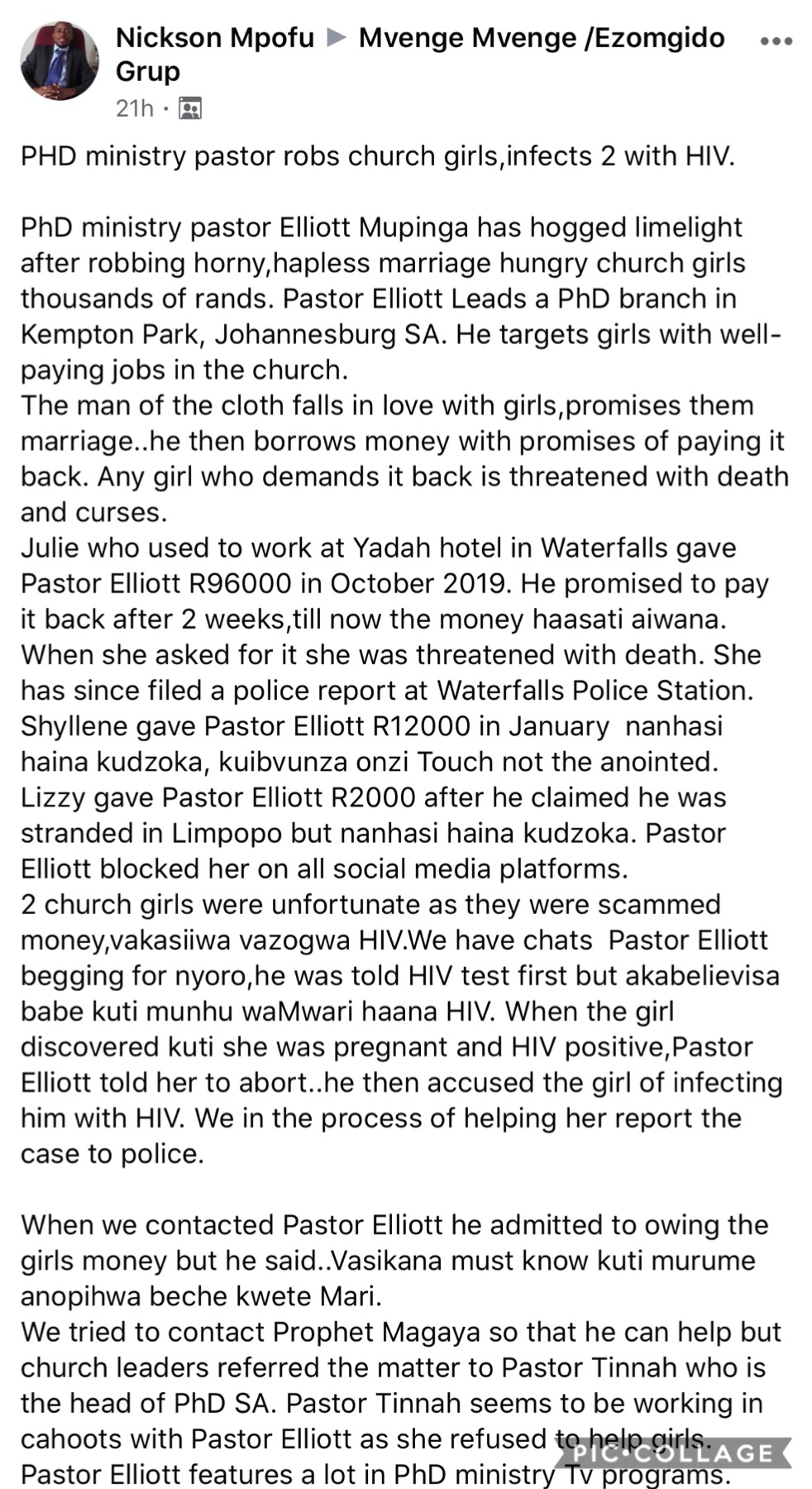
PHD ministry pastor robs church girls,infects 2 with HIV. 

PhD ministry pastor Elliott Mupinga has hogged limelight after robbing horny,hapless marriage hungry church girls thousands of rands. Pastor Elliott Leads a PhD branch in Kempton Park, Johannesburg SA. He targets girls with well-paying jobs in the church.
The man of the cloth falls in love with girls,promises them marriage..he then borrows money with promises of paying it back. Any girl who demands it back is threatened with death and curses.
Julie who used to work at Yadah hotel in Waterfalls gave Pastor Elliott R96000 in October 2019. He promised to pay it back after 2 weeks,till now the money haasati aiwana. When she asked for it she was threatened with death. She has since filed a police report at Waterfalls Police Station. Shyllene gave Pastor Elliott R12000 in January  nanhasi haina kudzoka, kuibvunza onzi Touch not the anointed. Lizzy gave Pastor Elliott R2000 after he claimed he was stranded in Limpopo but nanhasi haina kudzoka. Pastor Elliott blocked her on all social media platforms. 
2 church girls were unfortunate as they were scammed money,vakasiiwa vazogwa HIV.We have chats  Pastor Elliott begging for nyoro,he was told HIV test first but akabelievisa babe kuti munhu waMwari haana HIV. When the girl discovered kuti she was pregnant and HIV positive,Pastor Elliott told her to abort..he then accused the girl of infecting him with HIV. We in the process of helping her report the case to police.

When we contacted Pastor Elliott he admitted to owing the girls money but he said..Vasikana must know kuti murume anopihwa beche kwete Mari.
We tried to contact Prophet Magaya so that he can help but church leaders referred the matter to Pastor Tinnah who is the head of PhD SA. Pastor Tinnah seems to be working in cahoots with Pastor Elliott as she refused to help girls.
Pastor Elliott features a lot in PhD ministry Tv programs.

  • Share:

Info News

Best Mesothelioma Lawyer: How Asbestos Claims Work

Mesothelioma is a rare and serious cancer often linked to asbestos exposure. Many people who develop mesothelioma were exposed years earlier while working in construction, shipyards, factories, power plants, military service, or older buildings. Because the disease can take decades to appear, many victims do not realize where the exposure happened.

A mesothelioma lawyer helps victims and families pursue compensation from companies that manufactured, sold, or used asbestos products. These cases are different from regular injury claims because they often involve old job records, product history, medical evidence, and special asbestos trust funds.

One reason mesothelioma cases are important is the high cost of treatment. Patients may face surgery, chemotherapy, immunotherapy, travel costs, lost income, and long-term care needs. Compensation may help cover medical bills, household expenses, pain and suffering, and support for surviving family members.

A good mesothelioma attorney will investigate where and how the exposure happened. This may include reviewing work history, military records, union records, product lists, job sites, and company documents. Many asbestos companies knew the risks but failed to properly warn workers and consumers.

There are different ways to seek compensation. Some victims may qualify for asbestos trust fund claims. Others may file a lawsuit against responsible companies. In some cases, family members may file a wrongful death claim after losing a loved one to mesothelioma.

Timing is very important. Each state has a deadline called a statute of limitations. If you wait too long, you may lose the right to file a claim. That is why many families contact a lawyer soon after diagnosis.

The best mesothelioma lawyer should have experience handling asbestos cases, access to exposure databases, strong medical knowledge, and a clear fee structure. Most work on a contingency fee, meaning they only get paid if compensation is recovered.

Mesothelioma is devastating, but victims may have legal rights. If asbestos exposure caused the illness, a specialized lawyer can help families pursue justice and financial support.

Endpoint Detection and Response vs Antivirus: Business Guide

Traditional antivirus software helped businesses block known malware for many years. But modern attacks often involve stolen passwords, malicious scripts, remote access tools, fileless techniques, ransomware, and attackers who move through a network before launching the final attack. Endpoint detection and response, or EDR, is designed to provide deeper visibility and faster response than basic antivirus.

An endpoint is a device such as a laptop, desktop, server, or virtual machine. EDR software monitors endpoint activity for suspicious behavior. Instead of only checking whether a file matches a known virus signature, EDR can watch processes, command-line activity, network connections, registry changes, file behavior, privilege escalation, and lateral movement.

The key benefit is detection of behavior. For example, if a legitimate tool begins running unusual commands, disabling security settings, dumping credentials, or encrypting many files quickly, EDR may flag that activity even if no traditional virus is detected. This is important because attackers often use normal administrative tools to avoid detection.

EDR also supports investigation. Security teams can review what happened on a device, when it happened, which files were touched, what user account was involved, and whether other machines show similar activity. This timeline can help determine whether an alert is harmless or part of a real incident.

Response features vary by product. Many EDR tools can isolate a device from the network, stop a process, quarantine a file, roll back certain changes, collect forensic data, or trigger automated playbooks. Isolation can be valuable during a ransomware event because it can stop a compromised workstation from reaching shared files or other systems.

Managed detection and response, or MDR, adds human monitoring. Many small businesses do not have a security operations center. MDR providers review alerts, investigate suspicious activity, and help respond. This can be useful because EDR tools can generate alerts that require expertise to interpret.

Antivirus is not useless. Many EDR platforms include antivirus capabilities. The point is that antivirus alone may not provide enough visibility for today's threats. Businesses should think in layers: email security, multifactor authentication, patching, backups, firewall controls, DNS filtering, least privilege, security awareness, and EDR.

When evaluating EDR, ask what operating systems are supported, whether servers are included, how alerts are monitored, whether response is automated or human-led, how long data is retained, and whether reports are available for audits or cyber insurance. Also ask how the tool handles offline devices and remote workers.

Performance matters. Security software that slows machines can frustrate employees and lead to workarounds. Pilot the tool on a small group before full deployment. Include different device types and power users.

Integration is another consideration. EDR may connect with security information and event management systems, ticketing platforms, vulnerability scanners, identity providers, and firewalls. Integration helps correlate alerts across the environment.

Cost depends on the number of endpoints, feature level, retention period, support, and whether monitoring is included. A low-cost tool without monitoring may be fine for a business with internal security staff. A small company without security expertise may need MDR even if it costs more.

EDR is not a magic shield. Attackers can still succeed if passwords are weak, patches are missing, backups are exposed, or users approve malicious logins. But EDR can improve the chance of spotting suspicious behavior before it becomes a full business outage.

For many businesses, the question is no longer whether antivirus is installed. The better question is whether the company can detect and respond when something gets past the first layer. EDR helps answer that question.